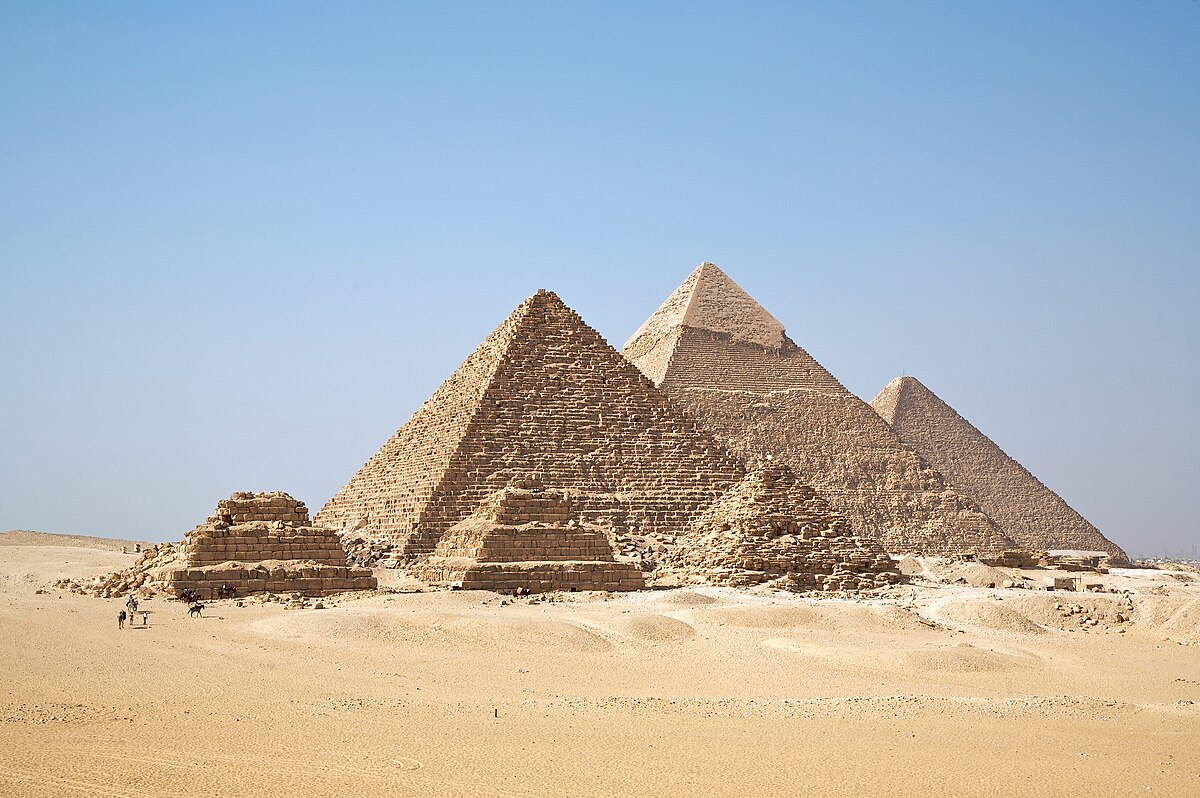
The Great Pyramid of Giza contains approximately 2.3 million stone blocks. Each block weighs between 2.5 and 15 tonnes. The structure rises 146 metres — taller than any building in the world until the 19th century. It was built in roughly 20 years, which means that during construction an average of 800 tonnes of stone was placed every single day, seven days a week, for two decades.
How this was accomplished has been the subject of speculation, myth, and pseudoscience for centuries. Aliens. Lost technology. Ancient magic. The reality — revealed through decades of serious archaeological work — is both more prosaic and more impressive than any of those theories.

Who Built the Pyramids
The most persistent myth about the pyramids is that they were built by slaves — specifically by enslaved Israelites as described in the Book of Exodus. This claim has been comprehensively disproved by archaeology.
In 1990, archaeologists discovered a cemetery near the Giza plateau containing the remains of pyramid builders. The bodies showed signs of hard physical labour — healed fractures, arthritis, wear patterns consistent with heavy lifting — but also signs of medical care. Workers had received treatment for injuries, including what appears to be surgical intervention in some cases. Slaves in the ancient world did not receive medical treatment.
The food remains found near the workers' settlement showed that pyramid builders ate well by ancient standards — beef, fish, bread, and beer in quantities that indicate a workforce being actively maintained rather than exploited to death. Egyptian records from the period describe workers being paid in grain, oil, and cloth — a wage system, not a slave system.
"The pyramid builders were not slaves. They were a rotating workforce of skilled craftsmen, specialised labourers, and conscripted workers serving a form of national service — building a monument that most of them probably believed had genuine cosmic significance."
The Workforce
Modern estimates put the permanent skilled workforce at around 20,000–30,000 people at peak construction. This was supplemented by a rotating workforce of conscripted labourers from across Egypt — farmers who worked on the pyramid during the annual Nile flood when their fields were underwater and agricultural work was impossible.
The logistics supporting this workforce were extraordinary. Bakeries capable of producing thousands of loaves per day have been discovered near Giza. Breweries producing large quantities of beer — the standard caloric supplement in ancient Egypt — have also been found. The construction of the Great Pyramid was as much a feat of supply chain management as it was of engineering.
How They Moved the Stones
The limestone blocks used for most of the pyramid's bulk were quarried nearby — some from within a kilometre of the construction site. The granite used for the interior chambers came from Aswan, approximately 800 kilometres to the south.
For the local limestone, evidence strongly suggests the blocks were moved on wooden sledges dragged by teams of workers over prepared surfaces. A remarkable discovery made in 2018 provides direct evidence: a painted tomb scene from the tomb of Djehutihotep shows workers pouring water in front of a large sledge carrying a colossal statue. Wet sand or mud dramatically reduces friction — experimental tests have shown that wetting the sand in front of a loaded sledge reduces the required pulling force by approximately 50%. The logistics suddenly become much more manageable.
For the granite blocks from Aswan, they were transported by boat down the Nile and then up a specially constructed canal that brought them close to the Giza plateau. A harbour has been discovered near the pyramid site, confirming waterborne transport.
How They Lifted the Stones
The most contested question in pyramid construction is how the blocks were raised as the pyramid grew taller. Several theories exist:
- External ramp: A single long ramp built alongside the pyramid and extended as the structure grew. Practical for the lower levels but would have required a ramp larger than the pyramid itself at full height — an enormous logistical challenge.
- Internal spiral ramp: Proposed by architect Jean-Pierre Houdin based on analysis of the pyramid's internal structure. A spiral ramp built inside the pyramid as it rose, which would avoid the massive external ramp problem. Evidence from microgravimetry surveys is suggestive but not conclusive.
- Multiple ramp system: Different ramp configurations used for different construction phases as the pyramid grew. This hybrid theory is currently favoured by many Egyptologists.
What About the Alien Theories?
The claim that aliens or a lost advanced civilisation built the pyramids is not taken seriously by archaeologists — not because of closed-mindedness, but because there is no evidence for it and substantial evidence against it.
We have the quarries where the stones were cut, with unfinished blocks still in place. We have the workers' villages, cemeteries, and administrative records. We have graffiti left by work gangs with names like "Friends of Khufu" scratched into stones inside the pyramid. We have the tools — copper chisels, granite hammering stones, wooden sledges. We have a developmental sequence showing earlier, cruder pyramids before the technical mastery of Giza was achieved.
The alien theory implicitly assumes that ancient Egyptians were incapable of building the pyramids without outside help. The archaeological record shows clearly that they were not only capable — they were systematic, organised, and skilled in ways that continue to impress modern engineers.

Why Were They Built?
The pyramids were tombs — but tombs of cosmic significance. Ancient Egyptian religious belief held that the pharaoh was a divine intermediary between the human world and the gods. After death, the pharaoh's spirit needed to ascend to join the gods in the heavens. The pyramid's shape — pointing toward the sky — was intentionally symbolic of this ascent. The precision of the cardinal alignment connected the structure to astronomical cycles that the Egyptians believed governed the afterlife.
Building the pyramid was not merely constructing a burial monument. It was participating in the maintenance of cosmic order — ensuring that the pharaoh completed his divine journey, which in turn ensured the continued functioning of the universe. In this context, the enormous investment of resources and labour makes complete sense. Nothing was more important.
Recommended Reading
Handpicked books to go deeper on this topic
As an Amazon Associate, Epochly earns from qualifying purchases. This helps keep our content free.